


2026-06-24
Postpartum depression in fathers: what it looks like and how to get help
Up to 1 in 10 new fathers experience postpartum depression—but it rarely looks like what you expect. Here is how to recognize it and what to do.
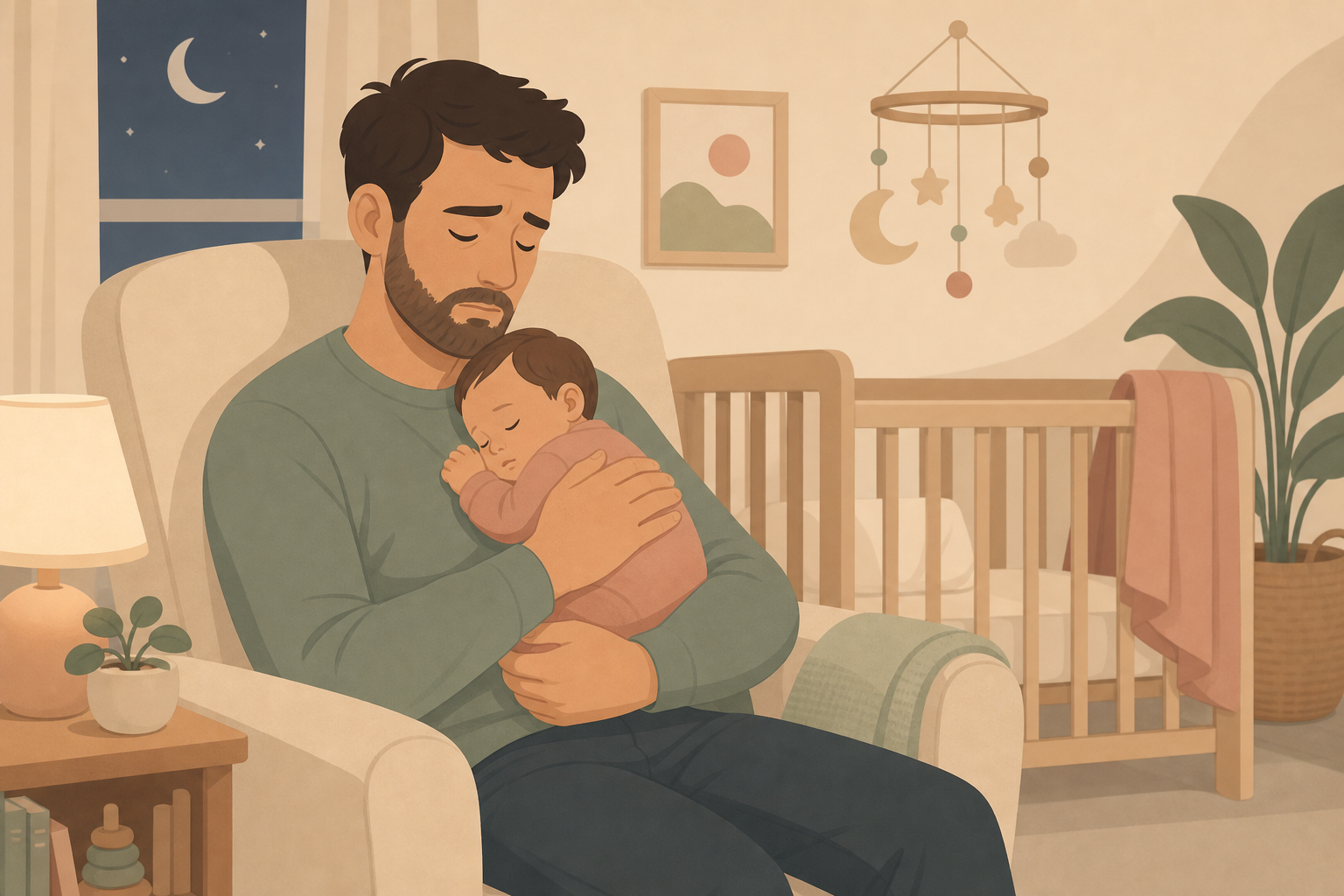
Postpartum depression is not only a mother's condition. Research consistently shows that up to 10% of new fathers experience clinically significant depression in the first year after birth—yet most go undiagnosed and untreated. This is not weakness. It is a recognized medical condition with effective treatments.
Why fathers get overlooked
Society's narrative focuses almost entirely on the birthing parent. Fathers are expected to be strong, supportive, and minimally affected. Asking for help can feel like admitting failure as a provider or partner. Many men also express depression differently—through irritability, overworking, numbing out with screens or alcohol, or withdrawing from the family rather than through visible sadness.
These "atypical" symptoms mean that standard depression questionnaires designed around women can miss paternal depression entirely.
What it actually looks like
Paternal postpartum depression can appear as:
- Persistent irritability, anger, or short temper—snapping at your partner over small things
- Emotional numbness or feeling detached from the baby
- Withdrawing from the family, spending more time at work or away from home
- Restlessness and difficulty relaxing even when the baby is settled
- Loss of interest in hobbies, friendships, or sex
- Increased alcohol consumption or other escapist behavior
- Intrusive thoughts—fear of harming the baby, catastrophizing about accidents or illness
- Feeling like a failure as a father or like your family would be better off without you
Feeling exhausted and overwhelmed in the first weeks is normal. When these feelings do not ease after a few weeks, or intensify, that is the signal to pay attention.
Risk factors
No single cause explains paternal depression, but several things increase risk:
- Partner's mental health: The strongest predictor of paternal depression is a partner who also has postpartum depression or anxiety. The relationship is bidirectional.
- Sleep deprivation: Severe, chronic sleep loss impairs emotional regulation. Fathers who share night duties are both more bonded and more vulnerable.
- History of depression or anxiety: Previous episodes raise risk significantly.
- Relationship strain: Conflict, reduced intimacy, or feeling like a third wheel in the mother-baby dyad.
- Financial pressure: A new baby often increases financial stress, especially with reduced household income.
- Isolation: Fathers often lose social contact quickly after birth—less paternity leave, less peer support, fewer community structures for new dads.
How to ask for help
The most important step is naming what is happening out loud. Telling your partner "I am not doing well" is not a burden—it is information your family needs. A few starting points:
- Talk to your GP or family doctor. A brief consultation and a validated screening tool (such as the Edinburgh Postnatal Depression Scale, which has a version adapted for men) can clarify whether what you are experiencing meets clinical thresholds.
- Tell your partner first. You do not need to have it figured out. "Something feels off and I think I need to talk to someone" is enough.
- Look for father-specific support groups. Many countries have dedicated networks (PANDAS Foundation in the UK, Postpartum Support International in the US) with father resources.
- Consider therapy. Cognitive behavioral therapy has strong evidence for postpartum depression. Many therapists now offer evening or online appointments that fit around work.
The connection to sleep and baby care
Poor sleep is both a cause and a consequence of paternal depression. Fathers who are actively involved in night care—even just one feed swap, or taking a shift while the mother sleeps—report stronger bonding and better long-term mental health than those who stay on the sidelines. Involvement reduces the feeling of helplessness that feeds depression.
If tracking feeds and wake windows helps you feel more useful and less chaotic at night, that structure is not just for the baby—it serves your mental health too.
When to seek urgent support
If you are having thoughts of suicide, harming yourself, or harming your baby or partner, contact a crisis line or emergency services immediately. These thoughts are a medical emergency, not a character flaw.
- UK: Samaritans 116 123 (24/7) or your GP/A&E
- US: 988 Suicide and Crisis Lifeline (call or text 988)
- Sweden: Mind självmordslinjen 90101
- Norway: Mental Helse 116 123
- Denmark: Livslinjen 70 201 201
References
- Paulson JF, Bazemore SD. Prenatal and postpartum depression in fathers and its association with maternal depression. JAMA. 2010;303(19):1961-1969.
- Postpartum Support International — Dads: https://www.postpartum.net/learn-more/men-and-perinatal-mental-health/
- PANDAS Foundation UK: https://pandasfoundation.org.uk/